
Spider Control · Treasure Valley
Spider Control in Boise & Meridian, ID
Spider control for Boise and Meridian that treats eaves, window frames and fence lines, not just the foundation. Free re-service.
Free inspection, and free re-service within 48 hours if they come back.
Spiders are the number one fall pest call across Ada and Canyon counties, and it is not close. From late August through the first hard frost our phones fill with Boise and Meridian homeowners who went from seeing the occasional spider to finding three in a week. Nothing has gone wrong with the house. The valley is doing what it does every year.
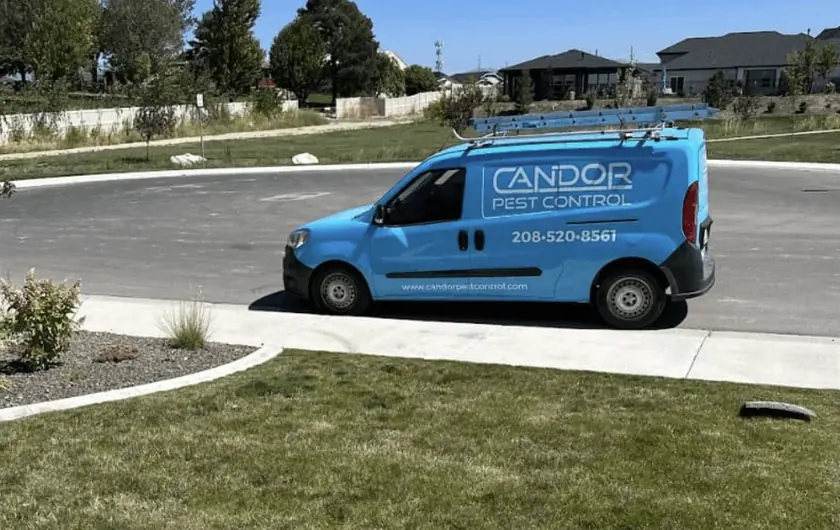
Candor Pest Control treats spiders where they actually live, which is rarely the middle of your living room floor. That means eaves and soffits, window and door frames, utility penetrations, landscape beds, woodpiles, fence lines and the yard. If spiders come back between scheduled visits, the re-service is free and we aim to have a technician on site within 48 hours.
Signs You Need Spider Control
A single spider in the garage in July is normal. A pattern is not. These are the signs worth acting on:
- Funnel-shaped webs in window wells, along foundation cracks, or in basement corners, which point to hobo spiders
- Messy, irregular webbing low down in a garage corner, crawlspace or under a deck, which is classic black widow construction
- Fast-moving brown spiders on the floor in the evening, most often male wolf spiders in wandering season
- Small pale spiders and their silk retreats in ceiling corners and behind picture frames
- Egg sacs, which look like tight cream or tan cotton balls, tucked into eaves or under the lip of siding
- Heavy insect activity around porch lights and soffits, which is the food supply that keeps spiders there
Spider Species in the Treasure Valley
Identification changes the plan. The spider you want removed today is not always the one that determines how we treat the property.
Black widow
The only spider in southwest Idaho with medically significant venom, and the one we prioritize. Females are glossy black with the red hourglass on the underside of the abdomen. They build low, close to the ground, in dry sheltered voids: window wells, meter boxes, the underside of deck joists, inside stacked landscape block, in garden pots that have not been moved since spring, and in the gaps of dry stacked rock.
Pressure is heaviest on dry, south-facing ground on the Boise Bench and the foothill lots above Hidden Springs and Avimor, and in the rock-and-gravel landscaping now standard across newer Kuna, Star and south Meridian subdivisions. That xeriscape style gives them the undisturbed voids they want. We treat those voids directly and remove egg sacs by hand.
Hobo spider
Common in Treasure Valley basements and crawlspaces, and consistently misidentified. Hobo spiders build flat, horizontal funnel webs at ground level and wait in the narrow end. They are poor climbers, so a spider in a bathtub or a basement window well is far more likely to be a hobo than one on a ceiling.
The reputation is worth correcting. The necrotic bite claim came from older research that has not held up, and the CDC no longer lists the hobo as a spider of medical concern. We have not seen a credible hobo bite injury in the Treasure Valley. A funnel web in your basement is still a funnel web, and the ground-level cracks, vents and window wells they use are treatable.
Wolf spider
The large, hairy, fast spider that causes most of the panicked October phone calls. Wolf spiders do not build webs. They hunt on the ground, which is why you see them crossing floors and sitting still on baseboards rather than hanging in a corner. They come in through door sweeps, garage gaps and the base of sliding doors.
They are the clearest example of why spider control has to happen outside. Wolf spiders live in turf, mulch and along irrigation ditch banks, so homes backing onto the Boise River Greenbelt through Garden City or onto open ground near Five Mile Creek take the most pressure. Treating the interior alone kills individual wanderers while the source population sits untouched thirty feet away.
Yellow sac spider
Small, pale yellow or straw colored, and responsible for a large share of the bites people attribute to something worse. Yellow sac spiders do not sit in webs. They build a small silk retreat in a ceiling corner, behind a headboard, in the fold of a curtain or under a picture frame, and they hunt at night by walking. Bites usually happen when one gets trapped against skin in bedding or clothing.
Because they live indoors and hunt on vertical surfaces, they are the one species where interior work genuinely matters. We treat upper wall and ceiling junctions, behind furniture and around window returns rather than the baseboard line.
| Species | Where you will find it | Web | Risk level |
|---|---|---|---|
| Black widow | Window wells, meter boxes, deck framing, stacked rock | Messy, low, irregular | Medically significant, treat promptly |
| Hobo spider | Basements, crawlspaces, foundation cracks, window wells | Flat funnel at ground level | Low, reputation overstated |
| Wolf spider | Lawns, mulch, canal banks, then indoors in fall | None, active hunter | Low, nuisance and startle factor |
| Yellow sac spider | Ceiling corners, behind furniture, bedding | Small silk retreat, not a catch web | Minor bites, most common indoor biter |
Why Fall Is Peak Spider Season in the Treasure Valley
Spider pressure here is driven by water, and water here is scheduled. The New York Canal, the Ridenbaugh Canal, the Settlers system through Meridian and the lateral ditches feeding Canyon County farm ground all run roughly April through October, holding soil moisture along their banks far longer than the surrounding dry ground. That moisture supports the midges, gnats and small flies spiders eat.
Two things then happen. Irrigation shuts down and the banks dry out, so both the insects and the spiders following them move toward whatever still holds humidity, which is the landscaped ground around your house. At the same time mature male spiders stop feeding and start wandering to find mates. That combination makes the last week of September through the end of October our busiest stretch of the year, and it is why spider activity here runs later into fall than in drier parts of the state.
| Season | What is happening | What you will see |
|---|---|---|
| March to May | Emergence | Overwintered spiders become active. Egg sacs from last fall begin hatching. |
| June to August | Building | Populations grow with the insect supply. Webs appear on eaves and porch ceilings. |
| September to October | Peak | Irrigation shutoff plus male wandering season. Heaviest indoor sightings of the year. |
| November to February | Indoors only | Outdoor activity stops. Anything still moving inside is overwintering in your walls, garage or crawlspace. |
How Our Spider Control Treatment Works
Every visit follows the same sequence, and your technician will tell you what they are finding as they go.
- Inspect and identify. Window wells, meter boxes, deck framing, the woodpile and the fence line come first, because that is where the species that matter are.
- De-web and remove egg sacs. Eaves, soffits, corners, porch ceilings and window frames get physically cleared. One egg sac left behind is a few hundred spiderlings in a month.
- Treat the harborage, not the lawn. Product goes into the cracks, voids and ledges spiders use, at label rate, placed precisely rather than broadcast across a yard.
- Cut the food supply. Reducing flying insects around soffits and exterior lighting does more for long-term spider numbers than anything else, which is where our ant control and general insect coverage overlap with spider work.
- Close the gaps. We flag the failed door sweep, the torn vent screen, the mulch banked against siding and the gap under the garage door, because those are the routes wolf spiders use.
- Return. If spiders come back between visits, the re-service is free and we target 48 hours.
Why DIY Spider Sprays Fall Short
Spiders are not a colony. There is no queen to remove and no single nest to collapse, so the logic that works on ants does not apply. A spider that sits in a web all day may barely contact treated ground at all, which is why spraying a web accomplishes little beyond removing the web.
What moves the number down is physical removal of webs and egg sacs, treatment placed into the specific voids and ledges spiders shelter in, and a sustained reduction in the insects feeding them. A retail aerosol does one of those three, briefly.
How Much Does Spider Control Cost in Boise and Meridian?
Most Treasure Valley homes handle spiders inside an ongoing protection plan rather than paying for individual callouts, because fall pressure returns every year whether or not you treated in spring.
Essential Protection starts at $39 a month. General pest control across 32 common insect species including all four spiders above, with free re-service between visits. Standard Protection is $49 a month and adds mice and other common household rodents. Complete Protection is $69 a month, our most popular, and adds mosquito and fly control with six monthly treatments through the season. Every plan runs quarterly or every other month, and against the September spider spike the every-other-month schedule is the one we usually recommend. Full details are on our pricing page.
One-time treatments are quoted after an inspection rather than over the phone. A townhome off Ustick Road and a half-acre lot on the Greenbelt in Garden City need different amounts of work. The inspection and quote are free, and if a single treatment is all you need we will say so.
There is a 12-month initial service agreement on the plans. The startup and initial service cost is waived or heavily discounted at enrollment, and the twelve months is how that discount is earned back. Cancel early and you reimburse the initial discount, nothing beyond that. After year one it runs month to month.
Spider Control Across the Treasure Valley
We run spider service from our Meridian headquarters on E Madrigal Street and our Garden City office on W State Street, covering Ada, Canyon, Gem, Payette, Owyhee and Boise counties plus Ontario, Oregon. Fall work is heaviest in Boise along the Bench and the Barber Valley side of town, across Meridian south of Lake Hazel Road, and in Nampa and Caldwell where lots meet open farm ground.
Spiders rarely show up alone. Where we pull black widows out of a window well we usually find earwigs and boxelder bugs in the same rock bed, and fall spider calls arrive alongside the first rodent activity of the season. Call (208) 795-9710 for a free inspection.
What to expect
Your Spider Control Visit, Step by Step
Inspection
We identify what you have, follow it back to the entry point, and check the conditions supporting it.
Treat
Targeted treatment where the pest actually is, plus full coverage of eaves, entry points, beds, fence line and yard.
Follow up
A return visit confirms it is gone rather than moved. Included, and typically within 48 hours if you call.
Reviews
What Treasure Valley Customers Say
Every review above is a verbatim Google review. Read all 589 on Google .
Questions
Spider Control Questions We Get Asked Most
How much does spider control cost in Boise?
Most Treasure Valley households handle spiders through an ongoing plan rather than paying per callout, and those start at $39 a month for Essential Protection. That covers 32 common insect species, so you are not buying a spider-only service. One-time treatments are quoted after an inspection, because a 1,200 square foot home on a Meridian interior lot and a property backing onto the Ridenbaugh Canal are not the same job.
Why do I suddenly see so many spiders in September and October?
Two things happen at once here. Irrigation shuts off through October and the ground dries, which pushes spiders and the insects they feed on toward the warmer, damper microclimate around your foundation. At the same time mature males stop building and start wandering to find females, which is why the big wolf spider crossing your living room floor in October is almost always a male.
Do you actually find black widows in the Treasure Valley?
Yes, regularly. They are the one species here worth a same-week call. We find them in window wells, under the lip of landscape rock, inside untouched garden pots, in meter boxes and along the underside of deck framing. South-facing foothill lots above Boise and dry rock landscaping in newer Kuna and Star subdivisions produce the most.
Is the hobo spider as dangerous as people say?
Probably not. The reputation for necrotic bites came from research later work has not supported, and the CDC removed the hobo from its venomous spider list years ago. We still treat them, because a funnel-web spider in your basement window well is a nuisance regardless. We would rather tell you that than sell you a scare.
Will one spider treatment clear the house?
One thorough treatment usually drops visible activity sharply within a week. Holding it takes repeat coverage, because spiders are not a colony you can collapse in a single hit. They keep walking in from the fence line, the woodpile and the canal bank, so the exterior barrier and the web removal have to be renewed on a schedule.
Are spider treatments safe around children and pets?
We use professional products registered for use in and around occupied homes, applied at label rate by licensed Idaho applicators, and placed precisely rather than blanket-sprayed across a whole yard. Keep children and pets off treated exterior surfaces until dry, which is usually under an hour. Tell your technician about fish tanks, chickens, beehives or an outdoor cat and they will work around them.
Does killing the insects in my yard reduce spiders?
It is the most reliable lever we have. Spiders settle where the food is, so a porch light drawing moths and midges off the canal bank all night is effectively a spider feeder. Reducing the flying insect load around eaves, soffits and exterior lighting does more for long-term spider numbers than any amount of spraying webs.
Do you remove webs and egg sacs or just spray?
We physically knock down webs and remove egg sacs from eaves, soffits, corners, window frames and porch ceilings on every visit. Leaving an egg sac in place means a few hundred spiderlings a few weeks later. De-webbing also tells us where activity is concentrating, which is how we decide where the next treatment goes.
Free inspection, honest quote
Get rid of the spiders for good.
Tell us what you have been seeing. We inspect the property, quote it honestly, and you decide from there.
- Rated 5.0 from 589 reviews Every one of them a verbatim Google review.
- Someone local answers 7:00 AM to 6:00 PM Mon to Fri, 8:00 AM to 2:00 PM Sat.
- Free re-service in 48 hours Pests back between visits? So are we, at no extra charge.